




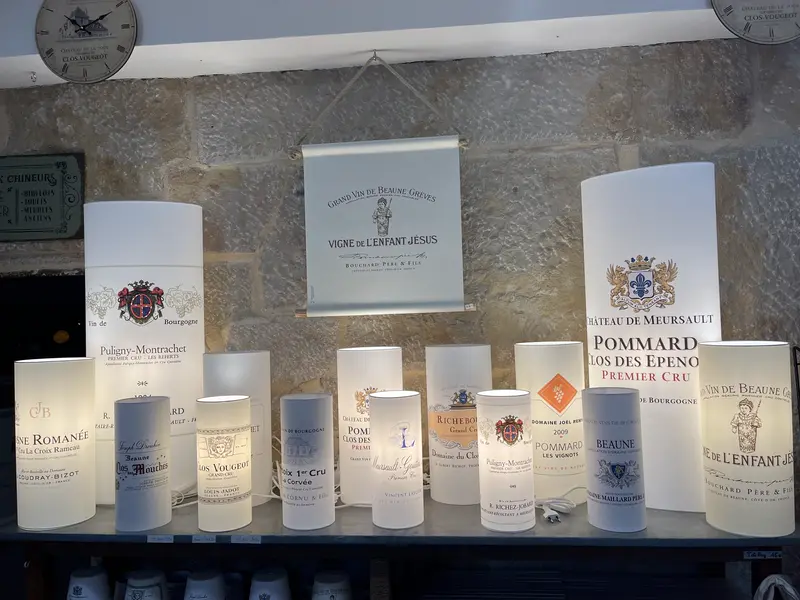
Our lamps, kakemonos and wall clock reproduce genuine Burgundy wine labels. Behind each label lies a village, a climat and an estate. Here, from the Côte de Nuits to the Côte de Beaune, are the appellations you will find in our shop.
Reading a Burgundy Label
In Burgundy, a wine bears the name of its place of origin, on four levels: regional appellations; villages (Beaune, Pommard, Meursault…); Premiers Crus, which combine the village with a climat (Pommard Premier Cru Clos des Épenots); and Grands Crus, which bear only the name of their climat (Clos Vougeot, Richebourg, Montrachet). A “climat” is a delimited, named vineyard plot; the Climats of the Burgundy vineyards have been a UNESCO World Heritage Site since 2015. Every term is explained, with examples, in our Burgundy wine label glossary.
Côte de Nuits
In the north, between Dijon and Nuits-Saint-Georges, the Côte de Nuits is above all the land of great red wines made from Pinot Noir.
Clos Vougeot
One of the most famous Grands Crus in Burgundy: a walled vineyard (clos) of about fifty hectares, planted by Cistercian monks in the Middle Ages around the Château du Clos de Vougeot. It is shared among many owners. Our labels: Louis Jadot (29 cm lamp, 39 cm lamp, kakemono) and Château de la Tour (wall clock).
The story: in the 12th century, the monks of Cîteaux Abbey cleared and planted this land, then enclosed it with walls; the château, with its medieval wine presses, is today the headquarters of the Confrérie des Chevaliers du Tastevin. On the Louis Jadot label, a head of Bacchus crowned with grapes and the words “Fondée en 1859” (founded in 1859); on our clock, a “mise au château” (château-bottled) label with a drawing of the Château de la Tour.
Vosne-Romanée
One of the most prestigious villages in Burgundy for its red wines. La Croix Rameau is a small climat there, classified as Premier Cru. Our label: J. Coudray-Bizot (29 cm lamp, 39 cm lamp, kakemono).
The story: the village is home to some of the most sought-after Pinot Noir Grands Crus in the world, including Richebourg. The J. Coudray-Bizot label combines a “CJB” monogram, the coat of arms of the Château de Beaufort and the words “Mis en bouteille au domaine” (estate bottled).
Richebourg
A red wine Grand Cru in the village of Vosne-Romanée, neighboring the most illustrious climats of the Côte de Nuits. Our label: Domaine du Clos Frantin (39 cm lamp).
The story: about 8 hectares, the second-largest Grand Cru of Vosne-Romanée by area. The label reproduced here, that of the Domaine du Clos Frantin (Albert Bichot, a Beaune wine house “since 1831”), sets the name of the cru in a gilded cartouche.
Côte de Beaune
In the south, around Beaune, the Côte de Beaune brings together great red wines (Pommard, Volnay, Corton) and the most famous white wines made from Chardonnay (Meursault, Corton-Charlemagne, Montrachet).
Aloxe-Corton
A village at the foot of the hill of Corton, north of Beaune, which produces mainly red wines. The Clos des Maréchaudes there is classified as Premier Cru. Our label: Domaine du Pavillon (29 cm lamp, kakemono).
The story: the hill of Corton, crowned with woods, produces both red wines and the white Grand Cru Corton-Charlemagne. The Clos des Maréchaudes of the Domaine du Pavillon is a monopole: the estate is its sole owner, as its label states.
Corton-Charlemagne
A white wine Grand Cru on the slopes of the hill of Corton; tradition links it to the Emperor Charlemagne, who is said to have owned vines there. Our label: Domaine Dubreuil-Fontaine (29 cm lamp, 39 cm lamp).
The story: according to legend, Charlemagne had white grape varieties planted on the hill so that the wine would no longer stain his beard. The label of Dubreuil-Fontaine, an estate in Pernand-Vergelesses, is designed around the chapel of Notre-Dame de Bonne Espérance.
Beaune
The capital of Burgundy wines and the town of the Hospices, Beaune gives its name to an appellation of red and white wines. Three Beaune labels in our selection:
- Beaune, Domaine Maillard Père & Fils (29 cm lamp, 39 cm lamp, kakemono);
- Beaune Clos des Mouches, a climat classified as Premier Cru, associated with the house of Joseph Drouhin (29 cm lamp, 39 cm lamp);
- Vigne de l'Enfant Jésus, a plot within the Beaune Grèves Premier Cru, owned by Bouchard Père & Fils (39 cm lamp).
The story: the names of these Beaune climats tell the story of the town. The Clos des Mouches owes its name to the “mouches à miel” (honey flies), the bees of the old beehives: the Joseph Drouhin label draws them around its Gothic lettering. The Vigne de l'Enfant Jésus, nearly 4 hectares in the heart of Les Grèves, belonged to the Carmelite nuns of Beaune; its name recalls the prophecy of Sister Marguerite du Saint-Sacrement foretelling the birth of the future Louis XIV. Bouchard Père & Fils acquired it in 1791, and the label shows the crowned Infant Jesus. Beaune is also the town of the Hospices, founded in 1443, whose wine auction takes place every third Sunday of November.
Pommard
An appellation of red wines made from Pinot Noir, renowned for their structure. The Clos des Épenots there is classified as Premier Cru. Our label: Château de Meursault (39 cm lamp).
The story: Pommard was one of the first Burgundy appellations to gain an international reputation for its reds. The Clos des Épenots is among its best-known Premiers Crus; the label reproduced here bears the coat of arms of the Château de Meursault and its motto, “Altum alii teneant.”
Volnay
Between Pommard and Meursault, Volnay is known for the finesse of its red wines. The Clos des 60 Ouvrées, classified as Premier Cru, is farmed by the Domaine de la Pousse d'Or (29 cm lamp).
The story: an ouvrée is an old Burgundian unit of measure, about 4.28 ares (428 m²), the area one man could work by hand in a day; 60 ouvrées therefore make a little over 2.5 hectares. This clos, enclosed within the Caillerets climat, is a monopole of the Pousse d'Or. The label reproduced here is that of a magnum (1,500 ml).
Meursault
One of the great white wine appellations of Burgundy. Two Premiers Crus in our selection:
- Meursault-Gouttes d'Or, Vincent Latour (29 cm lamp, 39 cm lamp, kakemono);
- Meursault-Perrières, whose name evokes the old stone quarries, Château de Meursault (29 cm lamp, 39 cm lamp).
The story: Meursault has no Grand Cru, but its Premiers Crus rank among the most highly regarded whites in Burgundy. The name Gouttes d'Or (“drops of gold”) evokes the color of its wines; that of Les Perrières, the old stone quarries. The Vincent Latour label bears a monogram topped by a tower; the Château de Meursault label, a fleur-de-lis coat of arms held by two griffins.
Montrachet, Bâtard-Montrachet and Puligny-Montrachet
Le Montrachet, a white wine Grand Cru straddling Puligny-Montrachet and Chassagne-Montrachet, is among the most famous white wines in the world. Our label: Olivier Leflaive (39 cm lamp, kakemono). The Bâtard-Montrachet Grand Cru (Olivier Leflaive) and the Puligny-Montrachet Premier Cru Les Referts (R. Richez-Jobard) are among the labels offered on our large 80 cm lamp.
The story: barely 8 hectares, shared almost equally between Puligny-Montrachet and Chassagne-Montrachet. Alexandre Dumas is credited with the advice that it should be drunk “kneeling, with head bared.” The Olivier Leflaive label, strikingly understated, comes down to a crowned shield, the name of the cru and the signature of the house.
What If Your Appellation Isn't Here?
Our lamps can be dressed with the label of your choice. Find out how to personalize your lamp, or read our guide to choosing your wine label lamp.
Passing through Beaune? Here is what to bring back from Beaune.
Advice
Further reading


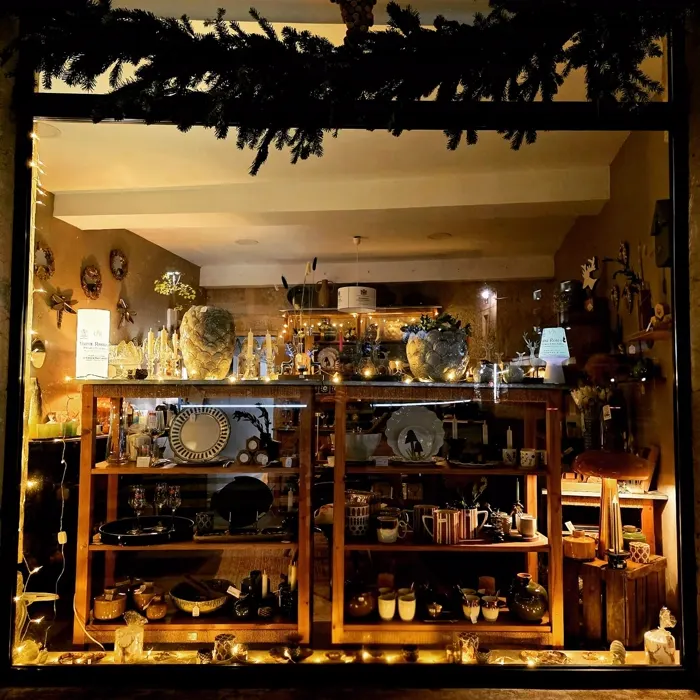
Beaune · Faubourg Madeleine
Come and see them lit up
All our wine label lamps are on display in the shop, along with our selection of home decor and tableware. Free in-store pickup for your orders.
Shop hours
- Tuesday → Saturday
- 10 h – 12 h 30 · 14 h – 19 h
- Sunday, Monday
- Closed
03 80 24 26 77